Friday, February 21, 2014

Grand kids make great subjects for portrait sculpture

I'm a little prejudice on the subject of depicting these little darlings.  I have been creating childrens' portrait 'heads' and 'busts' for over 40 years.  I have made portraits of some of my collectors grand kids but this is the first time I have worked on my own granddaughters sculpture.  Alexandra and her mother, Caroline have been
Ali sits at my 'Down Under Art Studio' in Portsmouth, NH
coming down to my studio in Portsmouth to sit for Ali's 'head'.  (A portrait 'head' differs from a portrait 'bust' in that the 'head' is sans shoulders and is a bit more informal in it's presentation.) The finished cast 'head' is mounted on a handsome block of marble or hardwood which will appoint the sculpture work. These pictures show the sculpture process about half-way through the sculpting or modeling process. Clay work unlike carving wood or stone which is only subtractive is the process of adding and subtracting; much like painting it allows a lot of subtlety and refinement to the completed work. The 'clay model' then has a negative mother mold made on it. From there a 'cast stone' or 'lost wax bronze' is created.

As you can see my subject doesn't really stay real still or pose
and posing is not really necessary.


I like to work from life, usually 3 or 4 two-hour sessions are all that is required. The sittings are filled in with photo's that I take at different stages of the sculpture. In other cases I work completely from photo's. The duel busts of 2 sisters pictured below was completed only from photographs supplied by my client. Notice the 'polychrome' patina. The 'patina' being the coloration of the sculpture and polychrome indicating a number of various colors. Finishing the sculpture in this way is really a look back to the way the ancients; Greeks would finish their marble carvings and bronze casts. I also could have completed this work in a variety of traditional bronze 'greens' or 'browns' which were typically arrived from by the washing of 'copper nitrate' for blue-green or 'ferric nitrate' for brown. The 'Sisters' are cast in 'stone' which has the advantage of being about half the overall cost of a 'lost wax bronze'.
"Sisters"   Cast Stone     (c) William Barth Osmundsen

Visit my "Down Under Art Studio"
at the
Ben Franklin Block Building
75 Congress St.,
Suite LO2
Portsmouth, NH

Tuesday, April 9, 2013

Southern Atlantic Ocean Rowers Capsized


After a 2,700 mile row and 73 days at sea our friend and Fox Sculpture advocate Jorden Hanssen and his crew had to abort their remarkable attempt to row across nearly 4,000 miles of ocean from the western coast of Africa, Dakar, Senegal to Miami, Florida.  This is one of the broadest stretches of open Atlantic Ocean.  The distance being about 1,000 miles longer than Harbo and Samuelsen's legendary North Atlantic crossing aboard Fox in 1896.

Hanssen and his 3-man crew were capsized in their 29 ft. ocean rowboat.  They were unable to right the boat and activated rescue beacons and a life raft which they maned while waiting for rescue.  Their journey ended about 400 miles north of Puerto Rico.

Capsizing is a real danger in any small boat ocean crossing.  In 1896, the Fox was broadsided mid-Atlantic and capsized however Harbo and Samuelsen both tossed out of the  boat, righted the 18 foot vessel, with handrails they had built especially on the keel. Loosing many articles and food stores they continued rowing north to the shipping lanes and hailed the Bark, Cito (a square sailing ship) who replenished the Fox's  supplies and gave Harbo and Samuelsen a meal onboard.  After their visit and weeks later, the Fox, 55 days from New York Harbor,  arrived at Britain's Sicily Islands.


Jorden in a letter supporting our Fox Sculpture Project credited his inspiration in ocean rowing to the original Fox crossing.  Although made in a comparatively primitive open wooden boat the Fox crossing was never bested for 114 years.

Whether these crossing are made by modern vessels or not they require the same legendary iron men that sailed wooden ships.  We know Jorden will return again to make continued attempts at ocean crossings.

You may like to learn more about Jorden Hanssen at his blog OAR Northwest or view his recent Today Show Interview.

Best regards, Bill

Friday, March 29, 2013

Voyage of the Fox - On open waters


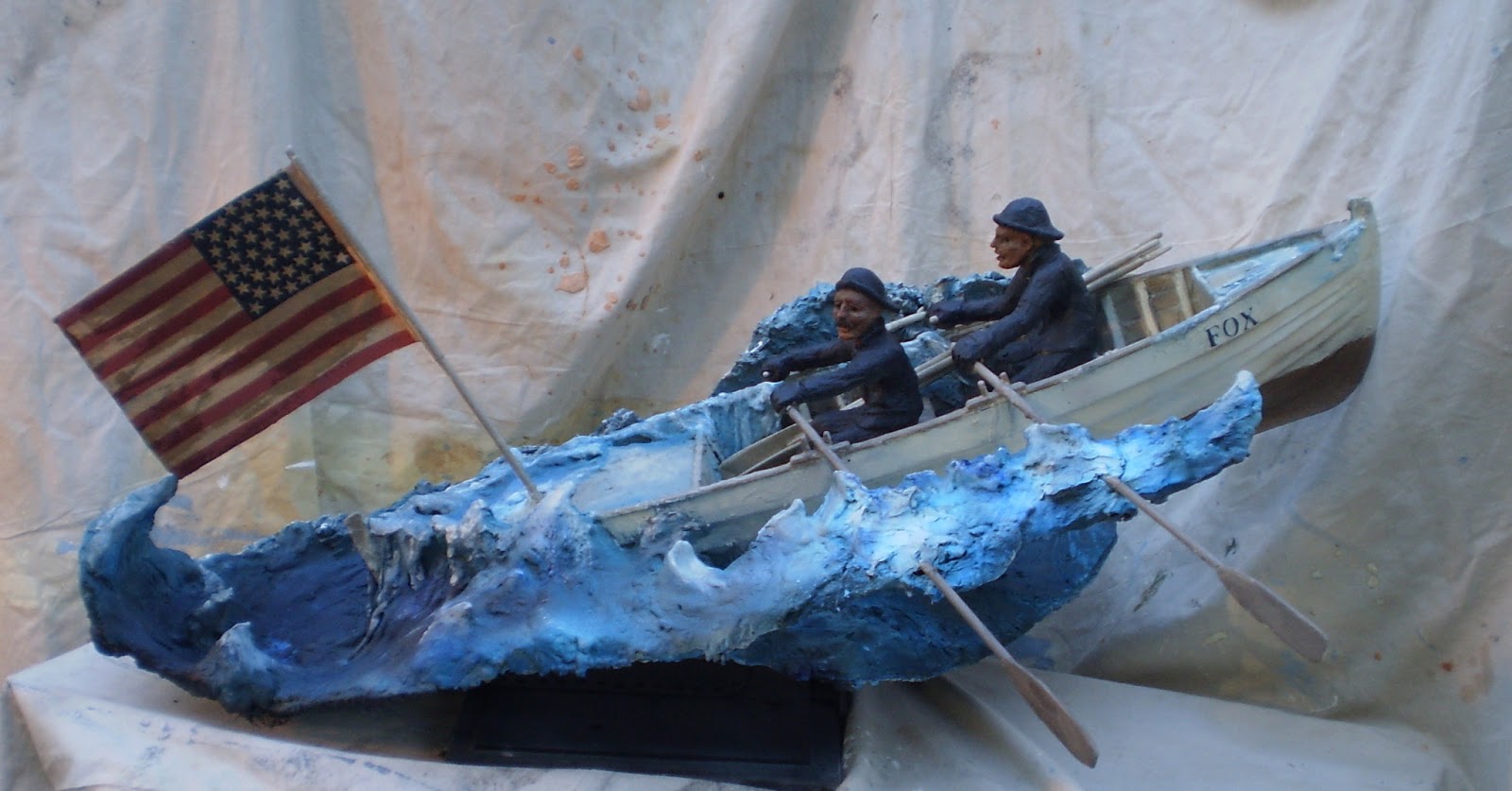
The 'Fox' an 18 foot rowboat was the first craft of this kind to cross the Atlantic Ocean, sans sail, motor, or rudder. The small open surf-boat' left New York's lower Battery on June 6th, 1896, crossing the Atlantic while plying the northern shipping route. The two Norwegian-American seamen, George Harbo and Frank Samuelsen, made the 3,000 mile trip to landfall, Sicily Islands, British Isles in 55 days. A record time which stood for 114 years. They continued on to Le Havre, France (the mouth of the Seine), exhibiting their boat there and Paris, Germany and Norway. They returned home from Copenhagen via a steamer arriving in Hoboken, a New Jersey port, later that year.
Their remarkable feat was soon almost forgotten.

This sculpture was created to honor these brave seamen and centuries of sailors who challenged the unpredictable Oceans of the World.

The 4 foot model depicted is the Marquette for an 8 ft. bronze monument (1/3 rd life-sized).

Bill Osmundsen, sculptor.
Victor Samuelsen, project manager

See our new SlideShare presentation by clicking project manager above.


Wednesday, May 9, 2012

Unwanted Ads placed without permision

I was surprised to find all this Advertising on my Blog site.


I certainly would have never allowed it if I had been asked.


It is poorly done and I will have it removed as soon as the 
Blog host will comply. 


Tuesday, September 13, 2011

Place of remembrance

'A time before 9/11"

A 4 foot Acrylic painting which the Artist hopes to use for the basis
of an
18 foot Tile Mural.

This past Sunday, the 10th Anniversary of 9/11, seemed to put to rest an unease which has pervaded our country. The ceremonies were understated in a very, very dignified way which echoed the marvelously thoughtful placement of the endless pools where the Trade Centers once stood. The beautiful bronzes engraved along the top edge of the cascading falls and the trees lining and giving protection from the harsh stone and steel city.

A firm named Snohetta, which means Snow Hood, in Norwegian created the only above ground building on the 8 acre memorial site. I invite you read my recent article about these Architects and 9/11 in the September 9, 2011 issue of the Norwegian American Weekly.

Best regards, Bill Osmundsen

for further reading on my mural project:- "A time before 9/11"

Wednesday, August 17, 2011

ON OPEN WATERS


“The Voyage of the Fox,” sculpture depicted here is the work of the article’s author, Bill Osmundsen. The prototype was created as a model for a bronze monument to be placed in New York and Norway. Further information about this project can be obtained by visiting the artist’s website: http://BronzeSea.org/FoxSculpture.aspx, or by contacting Project Coordinator, Victor Samuelsen at fantslake@aol.com or (203) 561-0005. Photo courtesy of Bill Osmundsen.

NORWEGIAN AMERICAN WEEKLY

On open waters: The Norwegian-American voyage of the FOX made the impossible a reality.

This year marks the 115th anniversary of the voyage of the FOX, the first transatlantic crossing by oar, in an open 18-foot rowboat named FOX. The nearly impossible feat was accomplished by two young Norwegian-American seamen who left New York June 6, 1896, and arrived in Le Havre, France on Aug. 7, 1896.

By Bill Osmundsen
Norwegian American Weekly

Around the time that Nansen was lauded for his polar achievement, two other Norwegians by birth – George Harbo and Frank Samuelsen – rowed more than 3,000 miles across the Atlantic Ocean in an 18-foot surfboat called FOX. They didn’t discover anything, but they did prove that through endurance and careful planning, two men in an open boat could actually achieve what was in 1896 believed impossible. If we look at their modest effort, compared to the mounting of the great expeditions of the Fram – Nansen, north and Amundsen south, they also exhibited great courage and fortitude and should join the ranks of explorers who have pushed the human limits. Harbo and Samuelsen were the first to successfully cross the Atlantic in an open rowboat.

READ THE REST OF THIS STORY at norway.com

Visit our Web Site:-BronzeSea.org

Monday, July 4, 2011

Happy July 4th

Frank Samuelsen, bow; George Harbo, stern; FOX, rowboat
Painting by Bart Forbes for Nautical Quarterly


Saturday July 4th
The night has been a stormy one. Wind shifting from south to N.N.W. and rained biggest part of the night.
8 a.m. Wind north, strong breeze and clear weather.
12 noon. Wind north, strong breeze. Course E.S.E. Day’s work 55 miles.
6 p.m. Wind N.E. light
This day we celebrated by washing our-selves in soap fresh water.
The first day our faces have seen good fresh water since leaving New York
.

On July 4th, 1896, in the middle of the Atlantic Ocean, two Norwegian-American seamen celebrated our Nations Birthday, by having a fresh water bath. It may not sound like much, no beer or hot dogs but for George Harbo, who wrote in the Log above and Frank Samuelsen, his rowing mate, it was the first time they took a break from their arduous trek across the Atlantic Ocean.

Harbo and Samuelsen were both new emigres from Norway to the United States but took care to carry the American Flag and make a point of taking a little time off on July 4th, for the bath.

George Harbo, the captain and navigator, of this first transatlantic crossing by rowboat, was particularly patriotic and had viewed the unveiling of the Statue of Liberty, from Bay Ridge, Brooklyn, on July 4th, in 1886, with his wife and their son Andrew, who he named after one of his hero's, an earlier American President, Andrew Jackson.

The marvelous illustration, at the head of this missive, was created by artist, Bart Forbes for Nautical Quarterly. The hardcover quarterly maritime magazine ran an article about the Fox, Harbo and Samuelsen, who rowed the 18 foot open boat successfully across the Atlantic, in a record (not to be broken for 114 years) time of 55 days. You can find Mr. Forbes' work and the article in NQ issue #4, published in 1978.

If you would like to view more of Bart Forbes' artworks and learn more about the artist, visit his web site:-
http://www.bartforbesgallery.com/

Enjoy your July 4th!

Cordially, Bill Osmundsen